
|
Chris Dorosz "Person Painted People" Scott Richards Contemporary Art - San Francisco, California by DeWitt Cheng 09/21/2026 |
|

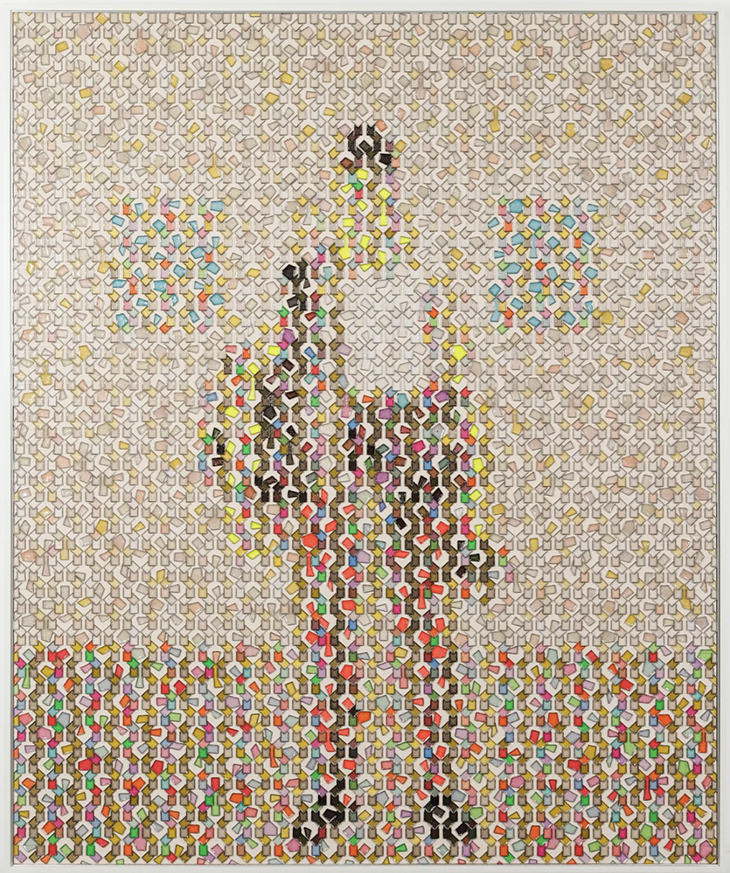
Chris Dorosz, “My Photographer Leif,” 2026, acrylic paint and gel medium poured to industrial staples on canvas, 40 1/2 x 33”. All images courtesy of Scott Richards Contemporary.
An old art-world joke defines sculpture as the thing you bump into from behind as you back away to better view a painting. The mixed-media wall sculptures of Chris Dorosz, a former San Franciscan now living in Winnipeg, turn that trope on its head: to take in the entirety of these modernist figurative works you will be compelled to foot-zoom (a technical photographic term for walking) up close to appreciate how these intricately crafted figures achieve psychological and philosophical impact without relying on mimesis.
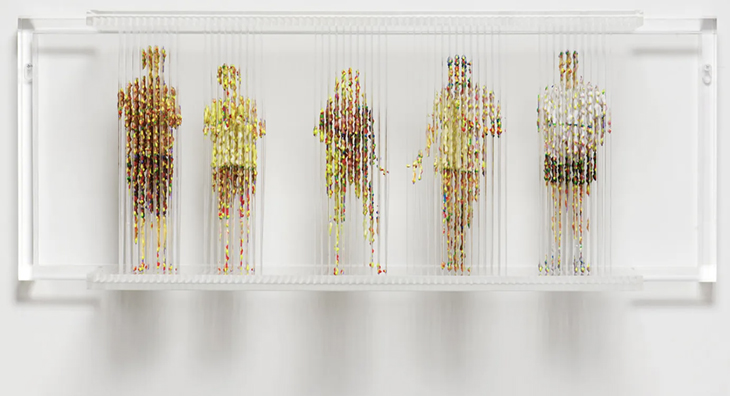
Chris Dorosz, “Stasis 147 (Firewalk-1),” 2023, acrylic paint on plastic rods, 12 1/2 x 34 x 8”.
“Person Painted People” features four works each from two series of Dorosz’s recent work, “Staple Paintings” and “Stasis.” The titles point out the paradoxes of representation in the conceptual, post-modern era. Representation derived from modernist abstraction takes reality as a starting point but then follows its own course, leading us to perceive dynamically and shift our mental framework (as well as one’s carefully backward footwork). Depictions of people are as old-school as it gets, but the ways in which Dorosz interprets and expands upon that hoary subject matter is the real point.
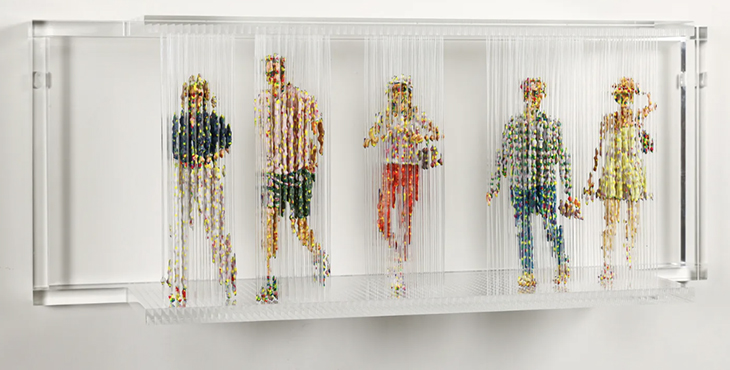
Chris Dorosz, “Stasis 151,” 2026, acrylic paint on plastic rods with Plexiglas support, 12 1/2 x 32 x 8”.
Dorosz builds on the analytical tradition of Cézanne, Giacometti, and Chuck Close, working in tiny discrete patches to build form empirically and incrementally. The standing figures in the “Staple Paintings” are posed frontally or in profile, as if for police file photos of lineup suspects, defying individuation. The industrial staples that define the color areas — liquid acrylic paint is poured into their enclosures — create a prismatic diffusion that dazzles the eye even as it obscures detail. Some images are borrowed from mass media; others are non-portrait renderings of unnamed family members, friends, and colleagues. “Stasis,” a synonym for stability, is an ambiguous title appropriate to Dorosz’s groupings of figures crafted from liquid acrylic allowed to drip down thin Plexiglas rods or threads of monofilament into uncannily lifelike configurations. It works despite the bright color of the paint blobs, suggestive of the dark, unseen universes of our viscera as depicted in anatomical charts. The verticals of the Plexiglas rods suggest rainfall, but also digital scanning — think of the deluge of fluorescent green digits in “The Matrix,” or the infinite torrent of immortal atoms in Epicurus’ and Lucretius’ largely but not completely mechanistic cosmology — infinite repetition modified by the occasional mutation. Dorosz’s ostensibly simple but meticulous manipulation of paint droplets yields complex food for thought.
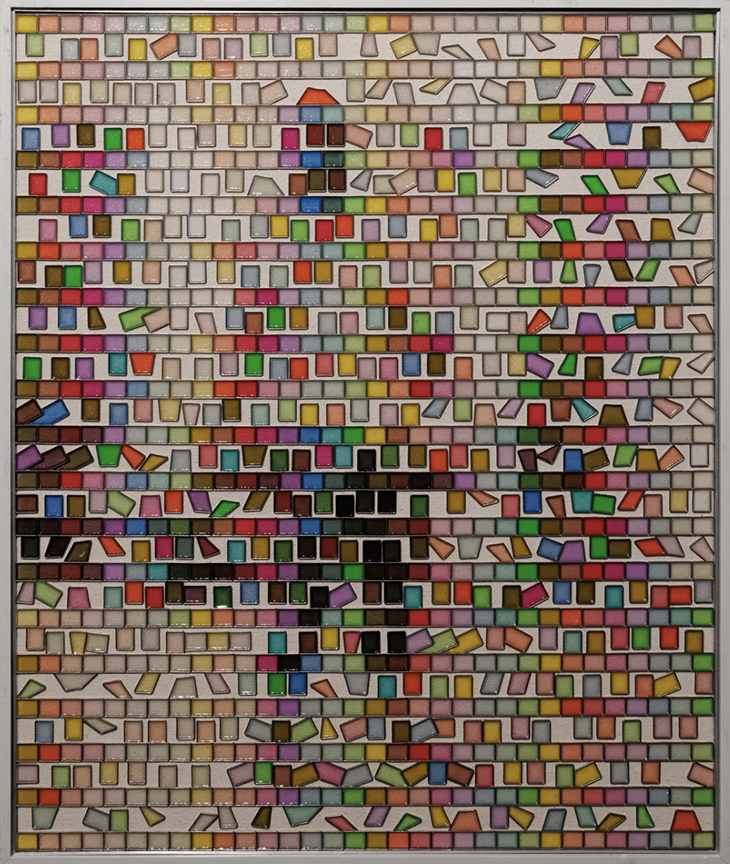
Chris Dorosz, “Man Holding Child,” 2026, acrylic paint and gel medium poured into industrial staples on canvas, 16 x 19”.
The artist’s interest in the psychic research of fellow Canadians Thomas and Lillian Hamilton during the paranormally obsessed 1920s is another factor impacting these ghostly, ectoplasmic works. Dorosz’s family on the maternal side was involved with the occultism of Theosophy and Golden Dawn, and one relative was the mother of the poet W.B. Yeats. The small blocky white maquettes that Dorosz makes to work out his figures have a kind of George Segal mystery and presence despite the vast size difference from Segal’s life-sized figures cast from live models. Dorosz’s group of miniature figures are generalized and anonymous but his source photos are of celebrities and other public figures. Everyone is seen democratically, as if by dispassionate airport X-ray scanners, with all passengers equal before the laws of optics and physics. It’s an aesthetic choice that cuts directly against our status-obsessed consumerist culture. Dorosz sees paint as imbued with “an organic sensibility which is … spiritual: ashes to ashes and dust to dust,” and congenial to conveying “the muddiness of being.”
The show’s title, “Person Painted People,” emphasizes the intimate, manual, meticulous and laborious origins of Dorosz’s work. Dorosz perspective is that “Art never provides answers; it must be left open-ended intentionally. That is why art that is too didactic or self-consciously political tends to fall flat.” Can artificial intelligence ever supplant the rigorous pursuit of artistic meaning exemplified by Dorosz’s anonymous “Man Holding Child” or “My Photographer Leif” from the “Staple Paintings,” or the contemporary Pompeiians, frozen in the midst of life, like living statues, in the “Stasis” groups? Will art be made of, for and about HAL 9000 and his Terminator brethren? Movie monsters always promise life eternal, with godlike powers. Oscar Wilde described art as “the most intense mode of individualism that the world has ever known.” Yes, we are all individuals!

